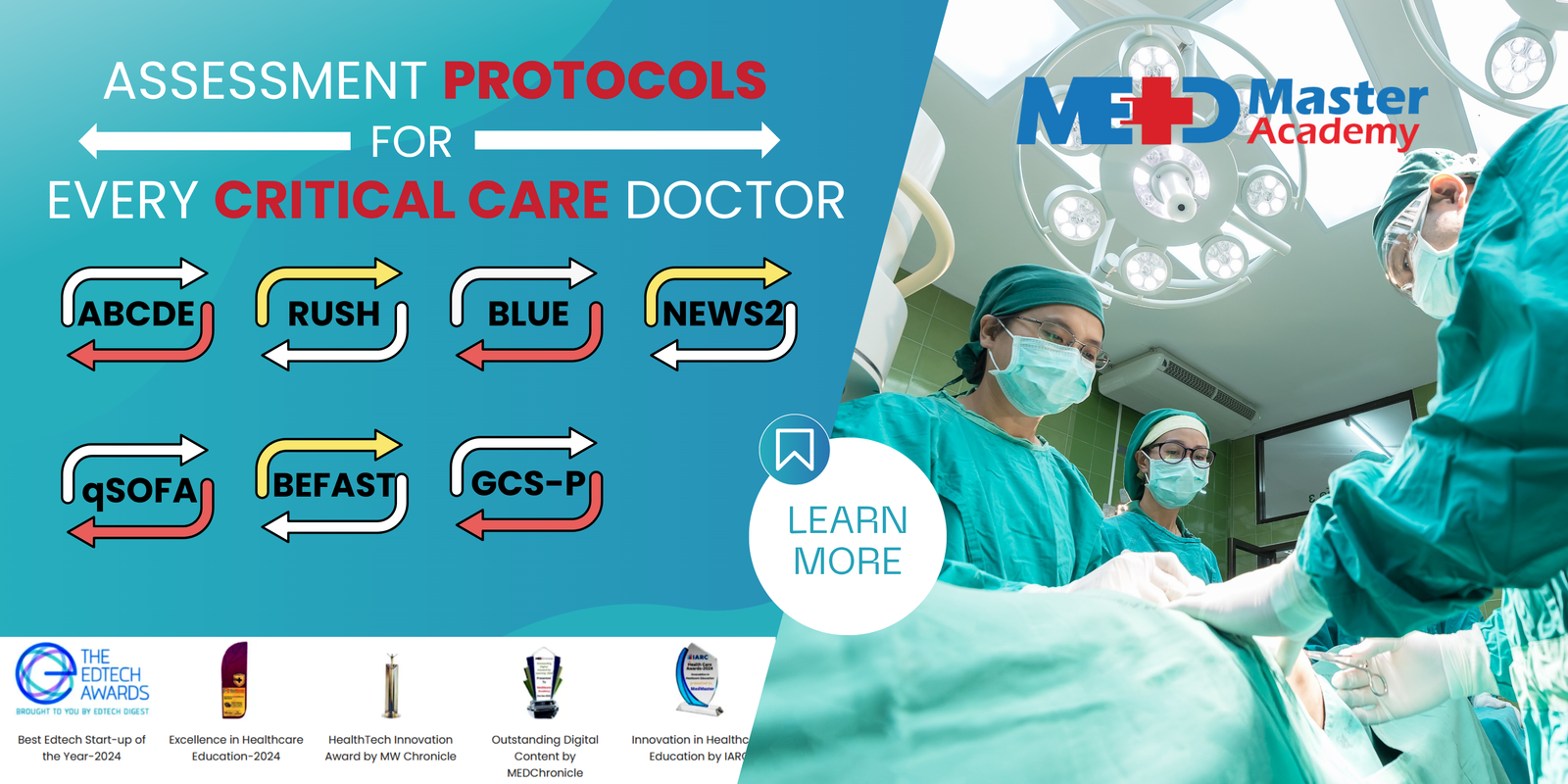
Top 7 Rapid Assessment Protocols Every Critical Care Doctor Must Master
Whether you are a medical officer, an emergency physician, or an aspiring intensivist, mastering these 7 rapid assessment algorithms is essential for bedside confidence and patient survival.
1. The ABCDE Approach (Primary Assessment Protocol)
The universal bedrock of emergency and critical care resuscitation, the ABCDE approach ensures structured identification of immediate life threats.
- Airway: Evaluate patent air passage, stridor, or compromise. Secure immediate airway management if needed.
- Breathing: Assess respiratory rate, work of breathing, chest expansion, and oxygen saturation.
- Circulation: Check capillary refill time, pulse volume, blood pressure, central perfusion, and IV access.
- Disability: Assess neurological status via AVPU (Alert, Voice, Pain, Unresponsive) or the Glasgow Coma Scale (GCS), along with pupil reactivity and blood glucose.
- Exposure: Fully expose the patient to inspect for rashes, hemorrhage, or trauma while preventing hypothermia.
2. The RUSH Protocol (Rapid Ultrasound in Shock)
When a patient presents with undifferentiated hypotension or circulatory collapse, point-of-care ultrasound (POCUS) delivers real-time diagnostic clarity. The RUSH protocol evaluates "The Pump, The Tank, and The Pipes."
- The Pump (Heart): Assesses cardiac contractility, pericardial effusion/tamponade, and right ventricular strain (pulmonary embolism).
- The Tank (Intravascular Volume): Evaluates inferior vena cava (IVC) collapsibility, pleural effusion, lung sliding (pneumothorax), and free fluid in the abdomen (FAST scan).
- The Pipes (Vessels): Scans for abdominal aortic aneurysm (AAA) and deep vein thrombosis (DVT).
3. The BLUE Protocol (Bedside Lung Ultrasound in Emergency)
Developed for patients experiencing acute respiratory distress, the BLUE protocol provides a step-by-step sonographic algorithm to pinpoint lung pathology in under 3 minutes with over 90% accuracy.
- A-Lines + Lung Sliding: Indicates normal lung parenchyma or asthma/COPD exacerbation.
- B-Lines (Comet Tails): Suggests pulmonary edema or interstitial syndrome.
- Absence of Lung Sliding + Lung Point: Diagnostic for pneumothorax.
- Subpleural Consolidation / Shred Sign: Points directly toward pneumonia or lung infarction.
4. NEWS2 (National Early Warning Score 2)
Recognizing subtle physiological decline before full-blown cardiac arrest is vital. NEWS2 is a clinical scoring tool that aggregates six routinely measured physiological parameters:
1.Respiration rate
2.Oxygen saturation (SpO2)
3.Systolic blood pressure
4.Pulse rate
5.Level of consciousness or new confusion
6.Body temperature
A rising NEWS2 score flags deteriorating patients early, triggering rapid response team (RRT) intervention before multi-organ failure sets in.
5. qSOFA & Sepsis-3 Identification Protocol
Sepsis is one of the leading causes of mortality in critical care units. The Quick SOFA (qSOFA) protocol serves as a fast bedside screening tool to identify patients outside the ICU who are at high risk for poor outcomes due to suspected sepsis.
qSOFA Criteria (1 point each):
- Altered mental status (GCS < 15)
- Fast respiratory rate (≥ 22 breaths/min)
- Low blood pressure (Systolic BP ≤ 100 mmHg)
A score of ≥ 2 mandates immediate sepsis bundle initiation: blood cultures, serum lactate measurement, broad-spectrum antibiotics, and fluid resuscitation.
6. The FAST / BE-FAST Protocol for Acute Stroke
Neurological emergencies demand immediate action to minimize neuronal loss. The BE-FAST framework allows rapid clinical triage of acute ischemic or hemorrhagic stroke before urgent neuroimaging:
- B - Balance: Sudden loss of balance or coordination.
- E - Eyes: Sudden loss of vision or double vision.
- F - Face: Facial drooping or asymmetry.
- A - Arms: Arm weakness or drift.
- S - Speech: Slurred speech or difficulty producing language.
- T - Time: Immediate activation of acute stroke team and CT imaging.
7. The GCS-P (Glasgow Coma Scale with Pupil Reactivity)
Assessing traumatic brain injury (TBI) and acute intracranial pressure (ICP) spikes requires a dynamic neurological monitoring protocol. The extended GCS-P incorporates pupil reactivity to refine prognosis in neurocritical care.
$$\text{GCS-P Score} = \text{GCS Total (3–15)} - \text{Pupil Reactivity Score (0–2)}$$
- Unreactive Pupils: Subtract 2 if both pupils are unreactive, subtract 1 if one pupil is unreactive, and 0 if both react normally.
- Clinical Utility: Captures brainstem compression and transtentorial herniation risks rapidly at the bedside.
Rapid Assessment Summary: Clinical Focus Area
| Protocol | Primary Clinical Indication | Core Diagnostic Focus |
|---|---|---|
| ABCDE | Initial triage & acute stabilization | Airway, breathing, systemic vitals, disability |
| RUSH | Undifferentiated shock / hypotension | Heart, volume status, major vessels via POCUS |
| BLUE | Acute respiratory failure & hypoxia | Lung ultrasound profiles (Pneumothorax, Edema, Pneumonia) |
| NEWS2 | Early deterioration monitoring | Aggregate physiological score for RRT activation |
| qSOFA | Suspected severe infection / Sepsis | Triage tool for high-risk sepsis progression |
| BE-FAST | Suspected acute cerebrovascular event | Rapid neurological & cranial nerve screening |
| GCS-P | Traumatic brain injury & neuro-ICU | Level of consciousness combined with brainstem reflexes |
Master Critical Care Protocols with MedMaster
Executing these protocols requires practice, structured clinical reasoning, and evidence-based guidance. The MedMaster Diploma in Critical Care is engineered to provide medical practitioners with in-depth training in mechanical ventilation, hemodynamic monitoring, sepsis management, and point-of-care diagnostics.
Bridge the gap between theory and bedside execution. Explore the MedMaster Diploma in Critical Careand elevate your ICU clinical performance today!
Explore more topics₹69,999/-
Enroll NowDiploma in Critical Care
Duration: 6 Months
Course Level: Diploma Programs
Language: English
₹141,000/-
Enroll NowFellowship in Critical Care
Duration: 12 Months
Course Level: Fellowship Programs
Language: English
Industry Partnership for Internship & Placements